
INTRODUCTION
Ambigolimax parvipenis Hutchinson, Reise et Schlitt, 2022 is a terrestrial slug species of uncertain native range inhabiting the British Isles, the USA, Portugal, Spain (including the Canary and Chafarinas islands), Greece, France, Hungary and Slovakia (Rowson et al. 2014, Vendetti et al. 2019, Hutchinson et al. 2022, Beninde et al. 2023, Hart et al. 2023, Turóci et al. 2023, Sánchez et al. 2025, Walker 2025, Čejka et al. 2025). For some time, the species was treated under the name Ambigolimax nyctelius (Bourguignat, 1861) (Rowson et al. 2014, Vendetti et al. 2019) (or Lehmannia nyctelia, see Borredà & Martinez-Ortí 2017) until Hutchinson et al. (2022) showed that it is an undescribed species characterised by the very short penis lacking the penial appendage.
The only Ambigolimax species known from Serbia until now is A. valentianus (A. Férussac, 1822), which was reported for the first time by Stojnić et al. (2011) indoors from a hotel garden, and which has been known only from that locality. In this work, we present the first record of the allochthonous slug A. parvipenis from a plant nursery in the city of Novi Sad. The species was found syntopically with A. valentianus. We also present new locality data for A. valentianus and report on its first outdoor occurrence in Serbia.
MATERIAL AND METHODS
Slugs were collected and left to drown in water for 24 hours. After the drowning process was completed, slugs were preserved in 70% ethanol. All specimens were dissected. Their genitalia were photographed using a Nikon SMZ800N stereomicroscope equipped with a Nikon DS-Fi2 camera. Scale bars were determined using a Nikon DS-L3 control unit. Living slugs were photographed with a Nikon Coolpix W300 digital camera. Specimens are stored in the Institute of Zoology, University of Belgrade, Faculty of Biology (IZOO).
RESULTS
Order Stylommatophora A. Schmidt, 1855
Family Limacidae Batsch, 1789
Genus Ambigolimax Pollonera, 1887
Ambigolimax parvipenis Hutchinson, Reise et Schlitt, 2022
Material examined: Serbia, South Bačka district, city of Novi Sad, Klisa part, plant nursery, 45°16'49"N, 19°50'38"E, leg. M. Vujić, 26 Aug. 2025, one specimen (specimen with genitalia dissected out: IZOO-MG-043, genitalia: IZOO-MG-044) (Fig. 1).
Figs. 1–3
Living specimens and distribution of Ambigolimax species in Serbia: 1 – distribution of both species in Serbia. Transparent red line indicates the area of continuous distribution of A. valentianus outdoors, observed three years consecutively; 2 – A. parvipenis from the city of Novi Sad; 3 – A. valentianus found syntopically with A. parvipenis in the city of Novi Sad. Larger scale bar 50 km, smaller scale bar 200 m
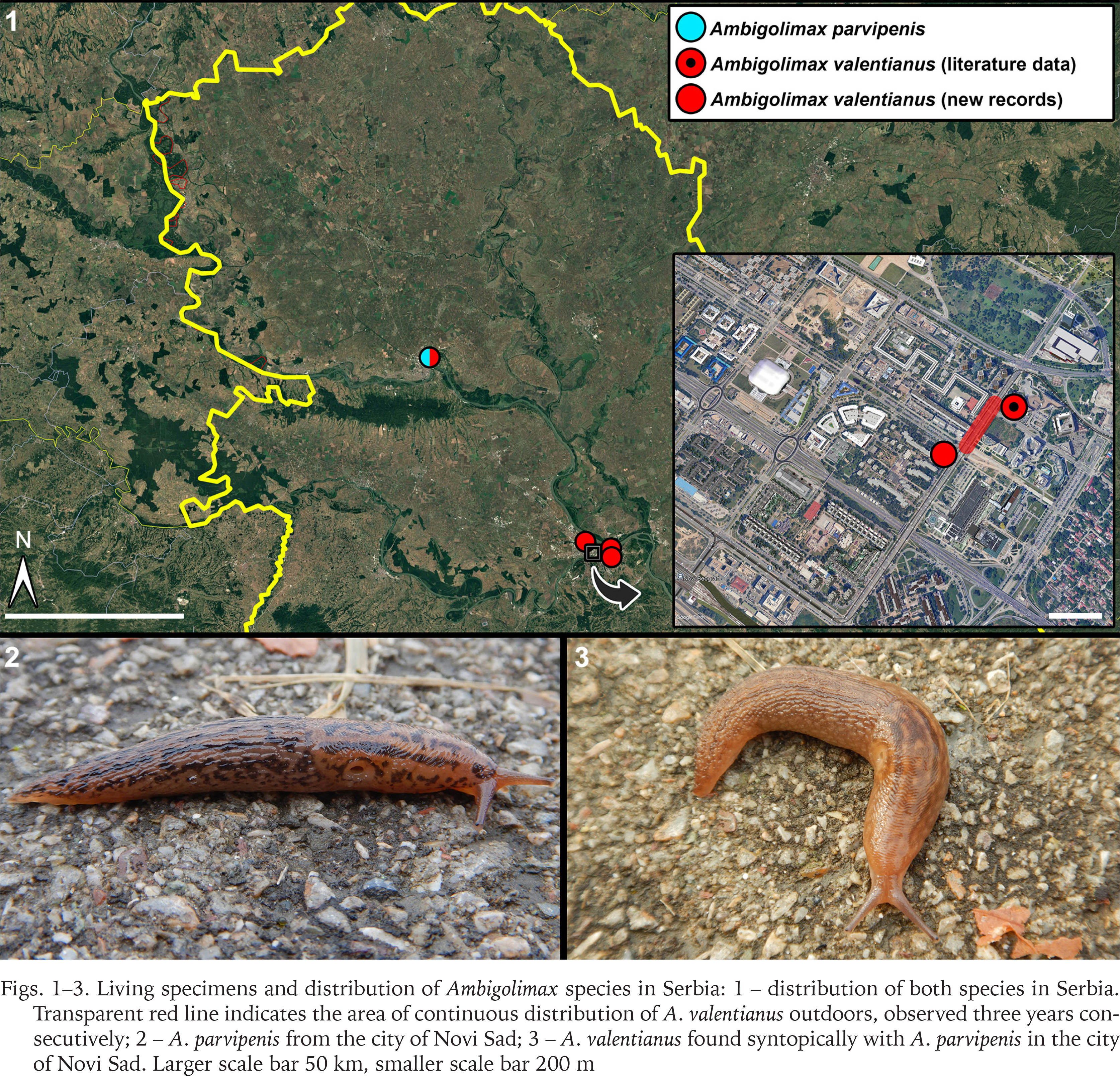
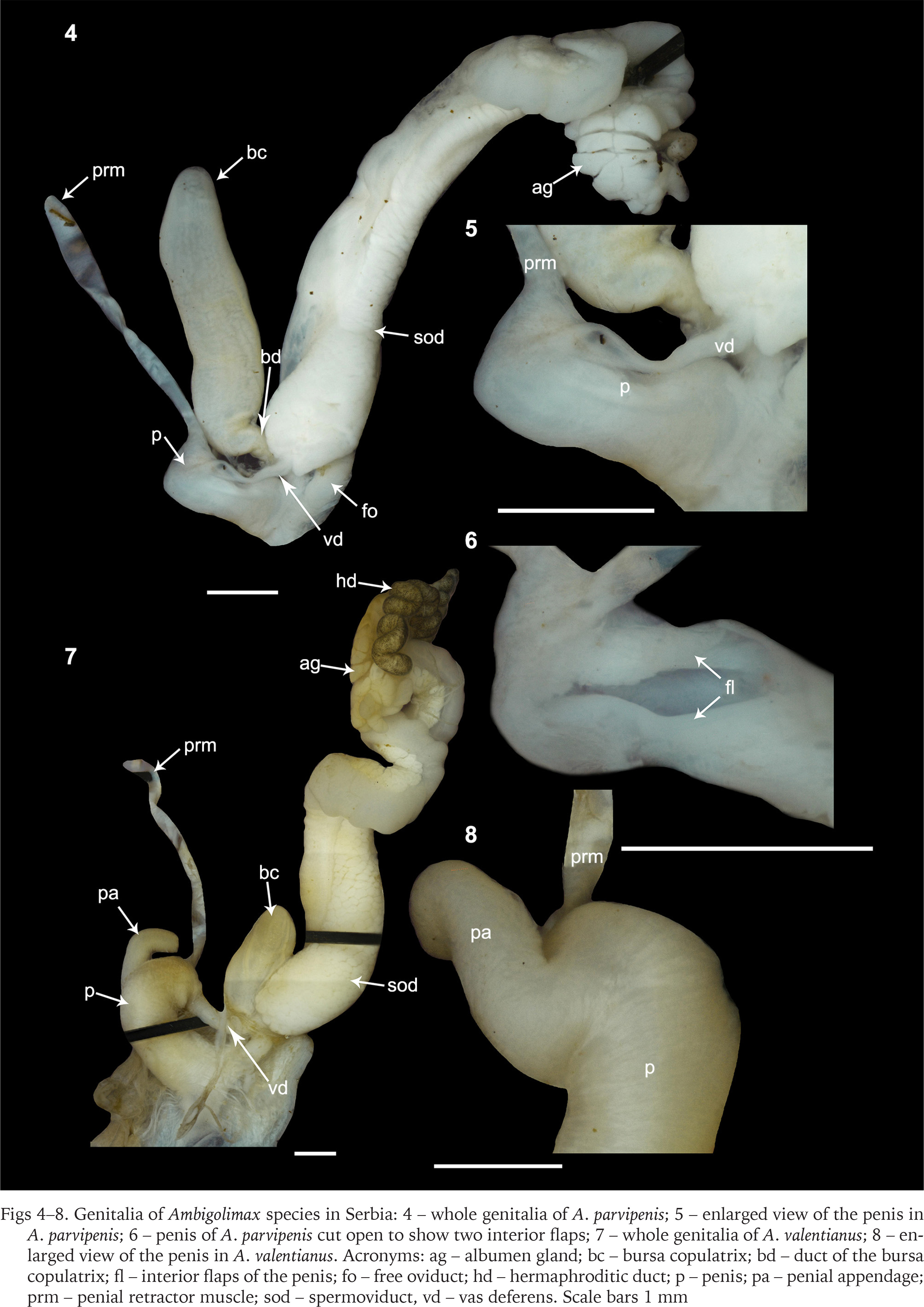
Notes: The single collected specimen (Fig. 2) of A. parvipenis was orangish, with numerous irregular dark markings. Laterally, irregular markings are smaller and randomly positioned. Dorsally, dark markings tend to form more regular stripes, of which two are most clearly visible, occurring on both dorsum and mantle. Between these stripes, numerous irregular markings are present, which is a tendency more usual for A. parvipenis than for other congeners (see Hutchinson et al. 2022). Our specimen (Fig. 2) showed the similar type of colouration as a specimen illustrated by Turóci & Páll-Gergely (2025: page 95, bottom left figure). The collected specimen showed all the anatomical characters usual for the species (Rowson et al. 2014, Hutchinson et al. 2022, Turóci et al. 2023), including a short penis (ca. half the length of the bursa copulatrix with its duct) which lacks the penial appendage (Figs 4–5). This is the most important character for distinguishing A. parvipenis from the very similar A. valentianus, which has a much longer penis with a well-developed appendage (Hutchinson et al. 2022, Turóci & Páll-Gergely 2025) (Figs 7–8).
Figs 4–8
Genitalia of Ambigolimax species in Serbia: 4 – whole genitalia of A. parvipenis; 5 – enlarged view of the penis in A. parvipenis; 6 – penis of A. parvipenis cut open to show two interior flaps; 7 – whole genitalia of A. valentianus; 8 – enlarged view of the penis in A. valentianus. Acronyms: ag – albumen gland; bc – bursa copulatrix; bd – duct of the bursa copulatrix; fl – interior flaps of the penis; fo – free oviduct; hd – hermaphroditic duct; p – penis; pa – penial appendage; prm – penial retractor muscle; sod – spermoviduct, vd – vas deferens. Scale bars 1 mm
Ambigolimax valentianus (A. Férussac, 1822)
Material examined: Serbia, South Bačka district, city of Novi Sad, Klisa part, plant nursery, 45°16'49"N, 19°50'38"E, leg. M. Vujić, 26 Aug. 2025, 10 specimens (whole specimens: IZOO-MG-038, genitalia: IZOO-MG-039); city of Belgrade, Novi Beograd, path from the Hyatt hotel towards the Block 22, continuously from 44°48'46"N, 20°26'00"E to 44°48'39"N, 20°25'49"E, leg. V. Gojšina, 01 Sept. 2025, three specimens (IZOO-MG-040); city of Belgrade, Jevremovac Botanical Garden, greenhouse, 44°48'57.02"N, 20°28'23.43"E, leg. M. Vujić, 27 Jan. 2024, one specimen (IZOO-MG-045); city of Belgrade, near the shopping centre, 44°47'11.10"N, 20°30'03.28"E, leg. M. Vujić, 26. Oct. 2025, five specimens (IZOO-MG-041); city of Belgrade, Pašino brdo, 44°47'17.81"N, 20°29'57.57"E, leg. M. Vujić, 24. Oct. 2025, one specimen (IZOO-MG-042); city of Belgrade, Novi Beograd, Block 8A, 44°50'04.79"N, 20°24'31.76"E, leg. V. Gojšina, M. Vujić, 10. Nov. 2025, two specimens (IZOO-MG-046) (Fig. 1).
Notes: Outdoors, A. valentianus was found amongst the potted plants, on the road as well as around rock rubble, with tens of specimens observed within a few minutes. Our specimens showed a fairly consistent tendency to have two narrow, dark longitudinal stripes on the dorsum as well as on the mantle (Fig. 3).
DISCUSSION
A single specimen of A. parvipenis was collected from a plant nursery in the city of Novi Sad, alongside 10 specimens of A. valentianus found syntopically. Specimens were mainly found under pots stored outdoors beneath the shade cloth, and placed on a waterproof sheet, resulting in the retention of moisture, soil, and debris under the pots where the individuals were found. On the same surface, plants imported from both northern Italy and the Netherlands were stored, so the country of origin of neither recorded species can be determined. It is also impossible to conclude whether the introduction was a singular event, or occurred several times with multiple plant imports. Rowson et al. (2014) mentioned that the penial appendage can be inverted into the penis in A. valentianus, and Hutchinson et al. (2022) noted that this may cause the confusion between the two species, which is why we dissected the interior of the penis. As we could locate only two flaps and no inverted appendage (Fig. 6), we confirmed the identity of our specimen as A. parvipenis. Eight specimens of A. valentianus had a normal penial appendage and two had no visible external appendage, but this structure was found when the penis was cut open, confirming that it was inverted. However, even without dissecting the penis, it was clear that these two specimens were indeed A. valentianus due to their much larger penis compared to A. parvipenis.
In Serbia, Ambigolimax parvipenis is currently limited to that one occurrence. Regarding A. valentianus, this species originates from the Iberian Peninsula, and nowadays has practically a worldwide distribution (e.g. Vendetti et al. 2019, Welter-Schultes 2012, Turóci & Páll-Gergely 2025 and references therein). This species was until recently in Serbia known only indoors, when it was reported from a hotel garden by Stojnić et al. (2011). We have found living slugs of this species outdoors in the immediate vicinity of the hotel, as well as in two surrounding areas (Block 21 and Block 22). Slugs have successfully established outdoor populations, as we observed them for three consecutive years at the same sites. Furthermore, the species was found in three more parts of Belgrade (Novi Beograd, Pašino brdo (and a nearby shopping centre) and Jevremovac Botanical Garden), distant from the hotel, suggesting at least a total of four independent introduction events.
The record of this species from a greenhouse in the Jevremovac Botanical Garden in Belgrade emphasises the importance of soil and plant transportation in the spread of non-native slugs. Given that a large number of individuals, primarily A. valentianus, were collected in the city of Novi Sad in a very short sampling period, it is most likely an established population. Both A. valentianus and A. parvipenis are known to be able to establish large populations (Horsák et al. 2004, Turóci & Páll-Gergely 2025). Horsák et al. (2004) have shown that large populations of A. valentianus in Czechia can cause damage to plants. While we can confirm that large populations of A. valentianus exist in Serbia (both in Belgrade and a plant nursery in Novi Sad), more research is still needed on their impact on the local environment.

